


CHARLES MICHEL NEVER LEFT THE FIRE
The Kandinsky Painting
The epiphany, as he calls it (which, he points out, means when the light is made) happened in New York in 2011 when he stood in front of a Kandisky painting at MoMA. The painting struck him magnetically. And he later found a quote from Kandinsky’s Concerning the Spiritual in Art: "Color is a means of exerting direct influence upon the soul. Color is a keyboard. The eye is the hammer. The soul is the piano, with its many strings"
“Yes, there is something spiritual in this art. But this painting is only perceived by my eyes. When beauty in food is presented, there is also smell, touch, taste. And it is art that keeps you alive.”
He bought the postcard at the gift shop. Turning it in his hands later, upside down, he saw a shape that looked like a mushroom. Then a salad. He thought: if I am inspired by these aesthetics, wouldn’t the colour, the form, the shape, touch the soul in the same way as Kandinsky… but then you can actually eat it? The idea of food paintings was born.
But there was a second strand to the origin, running beneath the epiphany in parallel. Something that had been building discomfort for years before New York gave it a form. He had trained in Michelin-starred kitchens, and he had found them, alongside their extraordinary craft, deeply troubling. The pressure, the mental health crises, the homophobia, the pervasive drug dependency. For six or seven years after leaving professional cooking, he did not enter a kitchen. He had a visceral reaction to being there that was not a good one. Oxford and academic thinking gave him a way back into cooking as as an offering and communal act. He returned to the kitchen only on his own terms: a pure language of gifting, or a generosity act. He has not cooked for money since.

We Lost the Hearth and Called It Progress
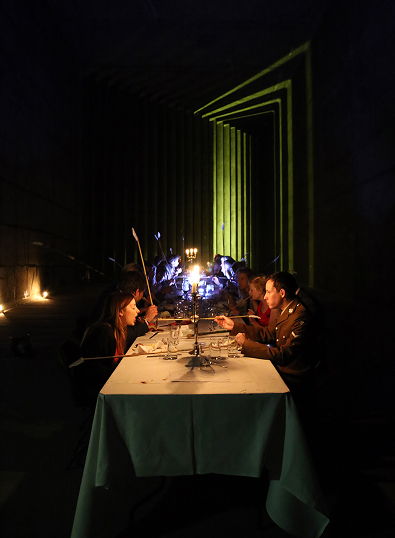
The argument Charles has been making for more than a decade: since Aristotle, Western philosophy has sorted the senses into a hierarchy. Sight and sound, the senses that reach upward, toward the divine are the higher faculties. Taste, touch, and smell, the senses of closeness, animality, survival are the lower ones. This, he says, is a Catholic slash Eurocentric worldview still quietly reproduced in the economics of culture. The Bolshoi for fifteen dollars. MoMA for thirty. The highest expressions of flavour as Michelin-starred gastronomy are three hundred minimum. There are no museums of food. Few institutions defend flavour as a cultural act. The hierarchy of philosophy became the hierarchy of funding. He traces this to a deeper disconnection: from nature, from being part of a system that preceded and will survive us. We have lost the village and the hearth. And in losing those things, we lost a form of beauty older and more primal than anything in a modern art gallery. His framework draws on evolutionary biology as readily as philosophy. He cites Denis Dutton's The Art Instinct: the peacock spending enormous energy on its plumage; the pufferfish constructing a perfect mandala on the seafloor, then swimming into it to wait for a mate. Beauty, on this account, is a signalling technology, a language that communicates the essence and continuity of life itself. Food, for Charles, is the most complete version of that technology. It engages more senses simultaneously than any other aesthetic form. It is relational in Nicolas Bourriaud's sense, the art is not the object but what happens between humans in its presence. When strangers eat from the same plate, some threshold is crossed. When sixty people gather around a food painting and the animality comes, as he puts it, something happens that sight and sound alone do not produce. Otherness dissolves. Commonality emerges.
“Food keeps you alive. Humanity can live without Kandinsky paintings. But we forget just how sacred food can be. It's a conduit between us and life itself.”
Sixty Years of Knowing What You Don't
Gastrophysics, the field Charles is helping define and now teaches, integrates psychophysics, chemistry, and the social sciences of food under one inquiry. It is also, as he acknowledges without flinching, a toolbox the food industry has been using for sixty years to hack human senses. The industry has known for decades that colour changes how food tastes, that the weight of cutlery affects how expensive a meal feels, that music modulates taste. This knowledge has been deployed systematically and asymmetrically: the companies know it and the consumers do not. He refuses the easy demonisation of industry. What we are all guilty of, he says, is convenience. The food industry did not create that tendency, it exploited it. The fault lies less in the system than in the absence of education that would allow people to see it clearly. His provocation goes further. You are what you eat is true but incomplete. The deeper formulation: you are what your food eats. Most monoculture crops are fed petrochemical fertilisers, which means, indirectly, your food is eating petroleum. The food system and the energy system are the same system. The solution he keeps returning to is structural: gastrophysics curricula, a pilot programme for five thousand Colombian children, kitchen labs where biology, chemistry, history, and geography are taught through food. The landscape has shifted since he started. People ask better questions. The sourdough has replaced the white bread. But the bakery selling sourdough is still the expensive one. The democracy of better food knowledge is still a work in progress, and its progress has been uneven.
The Beauty We Forgot Was Survival
Charles carries two childhood memories of food and they live in him as a kind of permanent dialectic. The first is his French grandmother's Soufflé au Fromage; risen perfectly, rushed to a table already seated, seconds to capture the moment before it fell. The second is a Colombian Christmas in the eastern Llanos. The veal sacrificed at sunrise. Forty people arriving by ten. The meat slow-cooking on embers all morning while children played in the river. By noon the elders tasted the first slices of Ternera a la Llanera. And when the feast ended, the bones went into a pot, simmered overnight into Sancocho de Mamona: the bone soup, and the ultimate closing of a forty-eight-hour experience. He is not choosing between them. The precision of French culinary tekhnē (art in ancient Greek) and the communal duration of the Colombian tradition are complementary technologies of beauty. The harmony between both, he says, is where he finds solace.
He is writing Hearth. The word, he says, is foyer in French, hoguera in spanish: the fireplace, the home fire, the centre around which families have gathered for eons. We have lost our Hearths. The atomisation of the family unit, the loneliness of elders, the absence of the village, these are not just social problems. They are aesthetic ones. They are a loss of a form of beauty that is one of the most primal available to live a good life. His food paintings continue. The largest was for sixty people. He describes it as a sight of strangers drawn to the canvas, their primevalness arises, playing, feeding, talking. Nicolas Bourriaud’s relational art made literal: the artwork is not the food painting. It is what happens between the sixty strangers who eat it, together. When asked what question he keeps returning to that his practice has not yet answered, he pauses. Then: “what is it in beauty that connects us to life itself?” To life as a force, a process that preceded us and will outlast us. Food is his medium for asking it, because food is the only aesthetic form that is also, literally, the continuation of that life. You are not just moved by it. You are made of it.